
Complete Care Guide for the Maidenhair Fern
Master the unforgiving mechanics of Adiantum. Learn how to manage the precise humidity and water physics required to keep this delicate lace alive.
The Quick Dirt
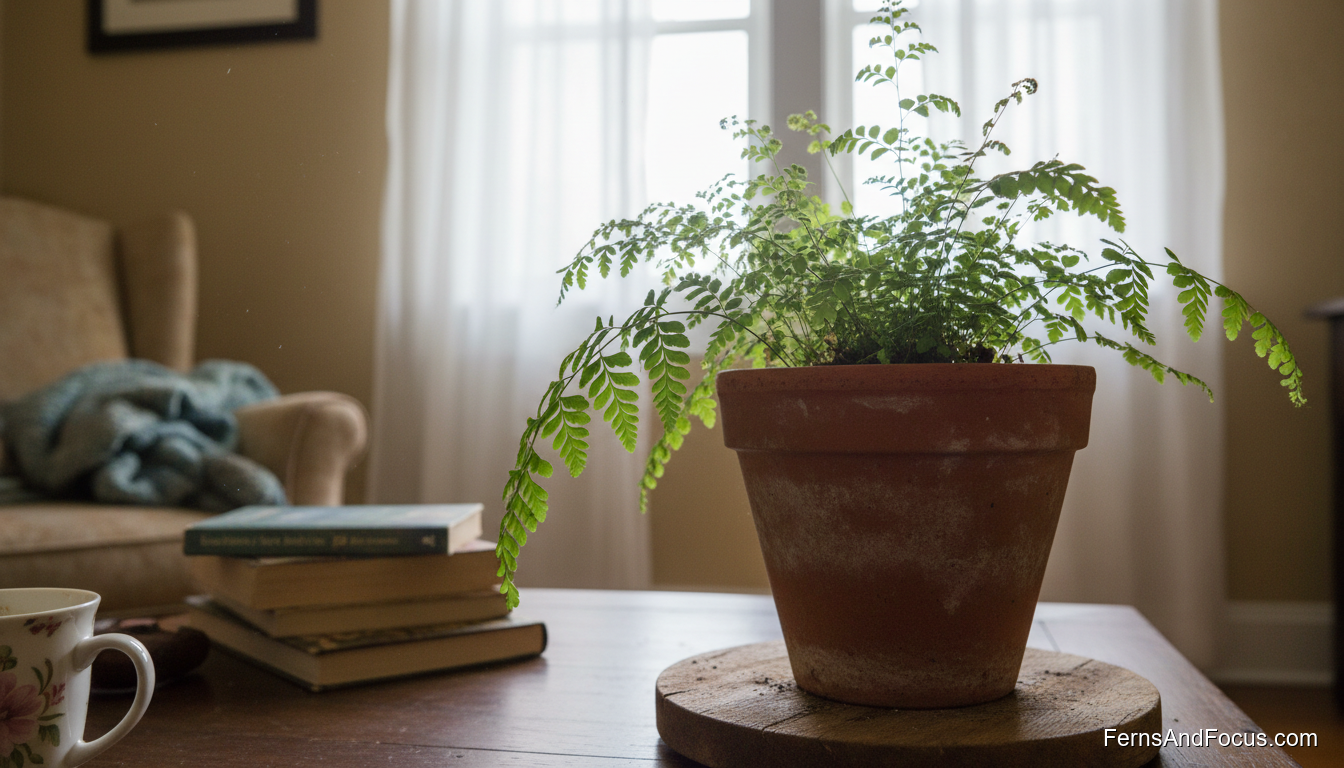
If you want a plant that demands your full attention, look at the Adiantum (Maidenhair Fern). It is a structural masterpiece of delicate lace and wiry stems that will not tolerate a single mistake in watering. It is the ultimate test for the observant mentor, rewarding consistency with a soft, cloud-like beauty that no other plant can match.
The Anatomy of Fragility
To grow a Maidenhair, you must first understand its build. Unlike a Pothos or a Rubber Plant, the Adiantum has zero storage capacity. Its leaflets, or pinnules, are paper-thin—only a few cells thick. They have no waxy cuticle to hold onto moisture and no fleshy stems to store water for later. This means that the plant is in a constant, high-speed exchange with its environment.
The stems, or rachises, are black and wire-like, giving the plant its delicate appearance. But don’t let the “wire” fool you; they are as fragile as the leaves they support. If the soil dries out even once, the pipeline from the roots to the fronds collapses. Because the leaflets are so thin, they desiccate (dry out) almost instantly once the water pressure drops. In the greenhouse, we say the Maidenhair is a plant that “lives in the now.” It has no past reserves and no future safety net. It is a biological machine that requires a 100% “up-time” on its water supply.
Humidity Physics: The Vapor Pressure Deficit
Humidity is often misunderstood as just “wet air,” but for a Maidenhair, it’s about physics. Every leaf has stomata—tiny pores that open to breathe. When they open, the plant loses water through transpiration. If the air in your home is dry, the “vapor pressure deficit” (the difference between the moisture inside the leaf and the moisture in the air) is too high. The air literally pulls the water out of the delicate fronds faster than the roots can pump it up.
This is why misting is a mechanical failure. Misting provides a burst of moisture that evaporates in minutes, leaving the plant back in the same dry “thirsty” air. For a Maidenhair, you need a steady-state environment. A dedicated humidifier is the only way to keep the humidity at the 60-70% level the plant needs to keep its stomata from panicking. Grouping it with other ferns or placing it in a bathroom with a window can create a small pocket of soft air. Airflow is also a factor; keep the plant away from AC vents or heaters that blow dry, high-velocity air directly onto the lace. You want the air to feel “soft and still.”
Water Logic: The “Never Dry” Mandate
With most plants, I tell people to wait for the soil to dry out. With a Maidenhair, that advice is a death sentence. The soil must remain consistently, uniformly damp—not soggy, but never dry. Think of the soil as a battery that must always be at 90% charge. The moment it hits 50%, the plant’s structural integrity begins to fail.
To achieve this consistency, you must develop a daily ritual of checking the soil tension. If you touch the surface and it doesn’t feel cool and damp, you’ve waited too long. Many mentors find success with self-watering pots or wicking systems for Maidenhairs because they remove the “human error” factor. A wick pulls water from a reservoir up into the soil through capillary action, maintaining a steady level of moisture that is hard to replicate manually. If you are watering by hand, do it from the top until it drains, but do it often. Waiting for a scheduled “watering day” will result in a pot full of brown, crispy lace. Consistency is the only tool that works here.
Light Filter: The Dappled Floor
In the wild, the Maidenhair lives on the shaded floors of canyons or near forest waterfalls. It is a master of low-energy photosynthesis. It doesn’t need the intense photons that a succulent or a ficus requires. In your home, this means you must provide “soft” light. A north or east-facing window is ideal, where the light is cool and steady.
If the light is too “sharp”—meaning direct sun hits the leaves—the thin tissue will bleach and burn within an hour. You’ll see the leaflets turn a pale, sickly yellow or a translucent brown. Conversely, if the light is too low, the plant will stop producing new fronds and the existing ones will look dull and dark. The goal is to find that “dappled” sweet spot where the plant can see the sky but the sun never touches the lace. If you can see a sharp, dark shadow when you hold your hand over the plant, the light is too intense. You want a soft, fuzzy shadow.
Soil Architecture: The Humus Mimic
The soil for a Maidenhair must mimic the rich, damp humus of a forest floor. This means a mix that is high in organic matter but still allows for gas exchange. I never use straight garden soil; it’s too heavy and will compact around the fine, hair-like roots. Instead, I use a mix of 50% peat moss or coco coir, which holds onto the moisture the plant craves, and 50% perlite or vermiculite to create air pockets.
Even though this plant wants to be “wet,” the roots still need oxygen. This is why drainage is still critical. You need a pot with holes so that when you add water, the “old” air is pushed out and fresh air is pulled in as the water drains. If the soil becomes a stagnant swamp, the roots will rot, and the plant will collapse even though the soil is wet. You’re looking for that perfect “sponge” texture—damp to the touch, but airy enough that your finger can easily penetrate the surface. Physics is the foundation of care here.
Recovery Mechanics: The “Haircut” Strategy
If you forget to water your Maidenhair and come home to a pot of dry, crispy lace, do not throw it away. Because the plant stores its dormant buds in a central rhizome at the soil line, it has a built-in “reset” button. The fronds themselves will never recover once they go brittle—the mechanical damage to the thin tissue is permanent.
When this happens, use a clean pair of shears and cut the entire plant back to the soil line. Remove every single crispy frond. It will look like a bare pot of dirt, but keep listening to the logic: if the roots are still healthy, the plant is simply waiting. Keep the soil damp and the humidity high. Within a few weeks, you’ll see tiny green “fiddleheads” beginning to emerge from the center. This is the plant’s second chance. Gardening is a practice of patience, and the Maidenhair’s ability to “reboot” is one of the most rewarding miracles in the greenhouse. Don’t give up on the roots just because the lace is gone.
Si’s Pro-Tip
If you’re having trouble maintaining the humidity, try the “Double Pot” method. Place your Maidenhair’s nursery pot inside a slightly larger decorative pot that has no drainage holes. Fill the space between the two pots with sphagnum moss and keep that moss wet. This creates a high-humidity micro-environment around the pot and the soil surface, acting as a buffer against the dry air of your home. It’s a simple mechanical fix for a complex environmental problem.
Keep your hands dirty and your plants happy.