
Complete Care Guide for the Snake Plant
The architectural anchor of the greenhouse. Learn the mechanics of nocturnal breathing and the drought-survival logic of the Snake Plant.
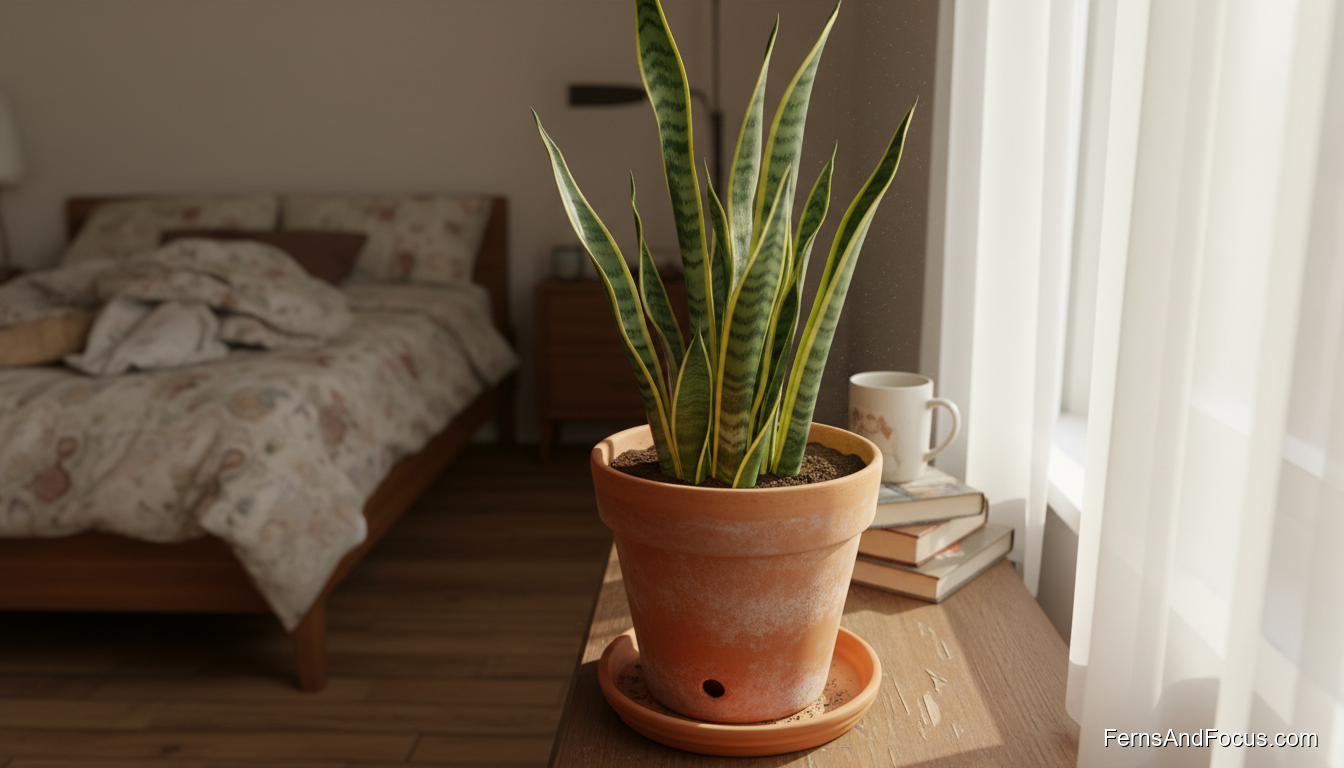
The Quick Dirt
If you want a plant that works while you sleep, look at the Dracaena trifasciata (Snake Plant). It is a vertical masterpiece that asks for almost nothing and provides a high-efficiency oxygen filter for your home. It thrives on respectful neglect and is the perfect starting point for any observant mentor.
The CAM Mechanic: Breathing at Night
Most plants breathe during the day, opening their stomata to take in carbon dioxide and releasing oxygen while the sun is up. The Snake Plant is different. It uses a specialized biological system called Crassulacean Acid Metabolism, or CAM. In its native arid environments in West Africa, opening its pores during the heat of the day would mean losing too much water to evaporation. Instead, the Snake Plant keeps its stomata tightly closed all day and only opens them at night when the air is cool and soft.
This nocturnal breathing cycle makes the Snake Plant a high-efficiency oxygen producer for a bedroom. While other plants are resting, it is actively absorbing carbon dioxide and converting it into organic acids to store for the next day’s photosynthesis. The trade-off for this water-saving efficiency is slow growth. Because the plant has to store its “breath” overnight before it can use the sun’s energy, it doesn’t have the metabolic speed of a tropical fern. It is a patient system, built for survival and long-term resilience rather than quick results.
Structural Architecture: The Turgid Leaf
The upright, sword-like form of the Snake Plant is a mechanical feat. It doesn’t have a woody trunk or a supportive stem; it relies entirely on turgor pressure—the internal water pressure within its cells—to stay vertical. Each leaf is a thick, fibrous structure designed to hold a massive amount of water. When the plant is hydrated, the cells are plump and rigid, acting like thousands of tiny supports that keep the leaf stiff and strong.
The danger comes when that internal pressure fails. If you see your Snake Plant starting to lean or fall over, it’s often a sign of a internal cell collapse. This can happen from extreme thirst, but more commonly, it’s a result of overwatering. When the roots sit in stagnant water, they begin to rot and can no longer pump water up into the leaves. The cells lose their tension, and the leaf becomes mushy and soft at the base. Conversely, if the plant is truly thirsty, you won’t see mush; you’ll see deep vertical wrinkles along the length of the leaf. These wrinkles are the only honest sign that the reservoir is low. Mushy leaves are a mechanical failure; wrinkled leaves are just a low tank.
Light Logic: The Adaptation Spectrum
One of the greatest myths in the greenhouse is that Snake Plants love low light. They certainly tolerate it better than almost any other plant, but that’s not the same thing. In deep shade, the plant enters a metabolic state of hibernation. It will stop growing entirely and its patterns will begin to fade into a muddy, solid green. This is light-starvation.
To maintain those beautiful “snake” patterns—the high-contrast horizontal banding and yellow borders—you need to give the plant access to photons. They thrive in bright, indirect light and can even handle several hours of direct morning sun. When the plant receives enough light, it has the energy to produce new pups from its rhizomes. If your plant hasn’t put out a new leaf in two years, it’s telling you its energy budget is too low. Move it closer to a window. The new growth will be thicker, the patterns will be sharper, and the plant will be a much more efficient oxygen machine. Sunlight is the fuel for its nocturnal work.
Water Physics: The “Empty Tank” Strategy
Watering a Snake Plant is an exercise in restraint. The plant has two primary reservoirs: the thick, fleshy leaves and the thick underground rhizome. This system is designed to run on empty for long periods. In most homes, you should only be watering once every three or four weeks.
The mechanics of failure here are almost always related to stagnant moisture. If the soil stays damp for more than a few days, the roots begin to suffocate and rot. This rot moves quickly into the base of the leaves, causing that mushy cell collapse I mentioned earlier. To avoid this, use the “wait-and-see” method. Stick a finger or a wooden chopstick all the way to the bottom of the pot. If there is even a hint of moisture, walk away. Only when the tank is 100% empty should you give it a deep, thorough soak. Watering a Snake Plant isn’t a chore; it’s a refilling of a long-term storage system. If the leaves are firm and upright, the tank is full. Trust the plant’s architecture.
Soil and Gas Exchange: The Gritty Foundation
The foundation of a healthy Snake Plant is drainage. Because the roots and rhizomes are so sensitive to rot, you need a soil that prioritize physics over nutrients. I never use regular potting soil for these plants—it’s too heavy and holds onto water for too long. Instead, use a mix that is at least 50% inorganic grit. A blend of high-quality potting soil, coarse sand, and perlite or pumice is ideal. This grit creates massive air pockets that ensure the roots can breathe even after a heavy watering.
The container is just as important as the soil. Terracotta is the gold standard for Snake Plants. The porous clay allows moisture to evaporate through the walls of the pot, which helps the soil dry down much faster than plastic or glazed ceramic. It also provides the weight needed to keep these top-heavy plants from tipping over. When choosing a pot size, don’t give them too much “legroom.” A tight fit encourages the plant to focus its energy on new leaf growth rather than exploring an oversized pot of damp soil. Keep it snug, keep it gritty, and the roots will stay healthy for decades.
Propagation: The Patience of the Pup
Propagating a Snake Plant is a lesson in biology. The most reliable method is rhizome division. During a repotting, you can see the thick, horizontal roots connecting the mother plant to its offspring, or “pups.” You can simply slice this connection with a clean blade, ensuring the pup has its own set of roots. This is a direct clone of the mother, maintaining all its patterns and variegation.
The more experimental method is leaf cuttings. You can take a healthy leaf, cut it into several three-inch sections, and place them base-down in water or soil. This is where it gets interesting: because of how the plant’s cells are structured, leaf cuttings of variegated Snake Plants (those with yellow borders) will almost always grow back as a solid green plant. The new pup emerges from the “non-variegated” tissue at the base of the cut. Whether you choose division or cuttings, the “callous” phase is critical. You must let the cut end dry out for at least 24 to 48 hours before placing it in any medium. This seals the wound and prevents the internal moisture from leaking out or attracting rot. Gardening is a practice of patience, and waiting for a Snake Plant pup to emerge is one of the longest, but most rewarding, waits in the greenhouse.
Si’s Pro-Tip
If your Snake Plant leaves are getting dusty, don’t just mist them. The thick waxy coating is designed to shed water, but it’s also where the plant breathes at night. Every month, take a damp cloth and gently wipe down both sides of each leaf. It opens up the “solar panels” and ensures the CAM cycle remains high-efficiency. If the leaves are dusty, the plant is effectively trying to breathe through a mask.
Keep your hands dirty and your plants happy.