
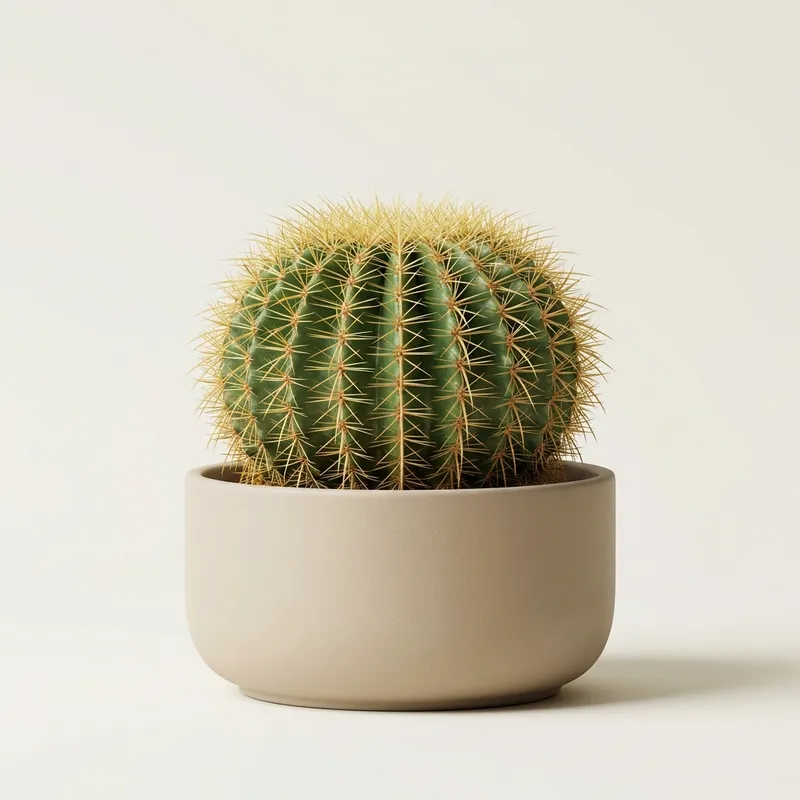
Golden Barrel Cactus
Echinocactus grusonii
The Golden Barrel Cactus is a striking, globe-shaped desert dweller famous for its brilliant yellow spines and symmetrical appearance. Native to central Mexico, this architectural plant can live for decades, eventually reaching substantial sizes. Its ribbed surface is densely covered in golden-yellow thorns that capture sunlight, giving the plant a luminous glow. It is a slow-growing specimen that adds a touch of the arid desert to any sunny indoor space.
Light
Full Sun
Water
Low
Difficulty
Easy
Humidity
Low
Pet Warning
While not chemically toxic or poisonous if ingested, the Golden Barrel Cactus is physically dangerous. Its long, rigid spines can cause deep puncture wounds and skin irritation to pets or children.
Care Guide
Golden Barrel Cactus Care Guide
Lighting
This plant requires intense, direct light. For indoor growth, a south-facing window that provides at least 6 to 8 hours of direct sunlight is essential to prevent etiolation and maintain the golden color of the spines.
Watering
Follow the 'soak and dry' method. Water the soil until it is saturated and allow the excess to drain completely. Do not water again until the soil is dry through to the bottom. In winter, water should be significantly reduced, often to once every 2 months.
Seasonal Tips
During summer, the cactus can be moved outdoors to a sunny patio. In winter, ensure it stays in a room above 50°F (10°C) and away from cold drafts, as it is not frost-hardy.
Common Issues
- Root Rot: This is the most common cause of death, usually from overwatering or poorly draining soil.
- Mealybugs: Check the deep ribs for white, cottony residue. Treat with 70% isopropyl alcohol on a cotton swab.
In-Depth Care & Growth
Feeding & Soil
Fertilizer
Low-nitrogen cactus fertilizer
Soil
Extremely well-draining mineral substrate, such as a mix of pumice, coarse sand, and perlite with minimal organic matter.
Physical Attributes
Mature Size
3 feet tall and 3 feet wide
Growth Rate
Slow
Propagation
Propagated via seeds; it rarely produces offsets (pups).